Essay | What might this be? by Amelia Groom
Department
Master of VoiceTutor documentation 2019-01-10
Essay What might this be? by Amelia Groom, theory tutor and thesis supervisor at finished Temporary Programme Master of Voice (2016-2018).
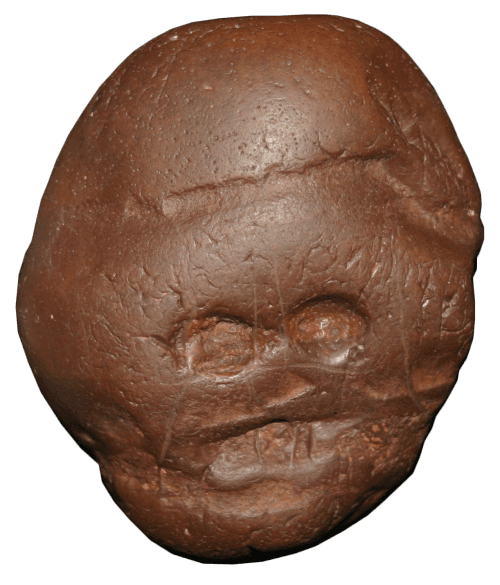
This is the Makapansgat Pebble. It’s a rock, with a face, and a name. It was found in the Makapan Valley in South Africa in 1925, in a cave that was inhabited by a now-extinct hominid ancestor of the human species, Australopithecus africanus, two and a half million years ago. We know that the pebble’s eyes and mouth were carved out by running water and neighbouring pebbles in a riverbed, rather than by hands. So it’s an image that was forged without any human-like invention or intention. But the cave where it was left is many miles away from any possible natural source, so paleo-anthropologists have speculated that it was picked up and transported, by someone who recognised the chance appearance of a face looking back.
The Natural History Museum in London identifies the Makapansgat Pebble as “perhaps the most ancient art object in the world.” The implication here is that it wasn’t art when it was sitting unnoticed in the river—but when it was pointed to, when it was picked out and displaced, it moved into the realm of artistry. If we accept this, we can say that art doesn’t begin with an act of creating something out of nothing, but with a moment of recognition that is actually a misrecognition: seeing a face where it isn’t, perceiving things as they aren’t. It isn’t inventing something new from scratch; it’s responding to what is already present, and treating it as something else.
I want to read into this capacity (or necessity) we have for reading into things. What does it mean that we can perceive more than what’s there? How much does all language—and all thinking and all meaning-making— depend on our ability to apprehend one thing in another thing? To what extent does perception always bring projective baggage along with it? What are the dangers and predicaments involved with the interpretative projections of our perceptions? And how might they be developed as part of critical engagement? Given that every critique of present conditions depends on the basic premise that reality could be otherwise, how can active misrecognition be deployed as a deliberately disobedient mode of looking, where we nurture our capacity to see beyond what it is that we are supposed to see?
In her essay On Being Ill, a bedbound Virginia Woolf is looking up at the sky and watching its incessant inventions. “This then has been going on all this time without our knowing it!” she remarks, shocked by the endless array of shapes and scenarios performed by the clouds. “Someone should write to The Times about it,” she decides. “One should not let this gigantic cinema play perpetually to an empty house.”1 There are two factors contributing to her experiencing the sky’s imagery as if for the first time. One is that she has to remain supine, for an extended duration, giving her body a spatial and temporal orientation towards the sky, which is something that isn’t granted to those upright bodies rushing about the city streets. The second contributing factor is the dis-orientation of illness; this is a text about the warped but enhanced sensitivity that can be brought on when we are unwell. Woolf writes of the “mystic quality” that words can come to possess when language is rendered incomprehensible; as when feverish or otherwise delirious states take us to the edges of meaning, where other meanings might emerge.2
Hallucination can be a tricky thing to ascertain the boundaries of, as it will often arise from a combination of external reality with internal processing, and it can overlap with simple misperception. But the perceptual disturbances and persecutory delusions that can be experienced with psychosis or schizophrenia, for example, are largely beyond the bounds of what I want to consider in this text. There are psychological conditions in which hallucinations are involuntary and harrowing (Woolf wrote in her suicide note of the intolerability of beginning to hear voices again)—and then there are much more general experiences of mis-reading or actively over-reading an external stimulus, such as when we ‘see’ faces or animals in the clouds. We might be especially attuned to this sort of over-reading of random details when we are in particular states (when we’re feverish, when we’re on psychedelics, when we’re children, when we’re sleep deprived, when we’re socially anxious)—but we also do it all the time, because perception involves not only the passive reception of external stimulus but also aspects of our own memories and anticipations. To some degree, it is always interpretative and imaginative.
Read on: http://ameliagroom.com/what-might-this-be/