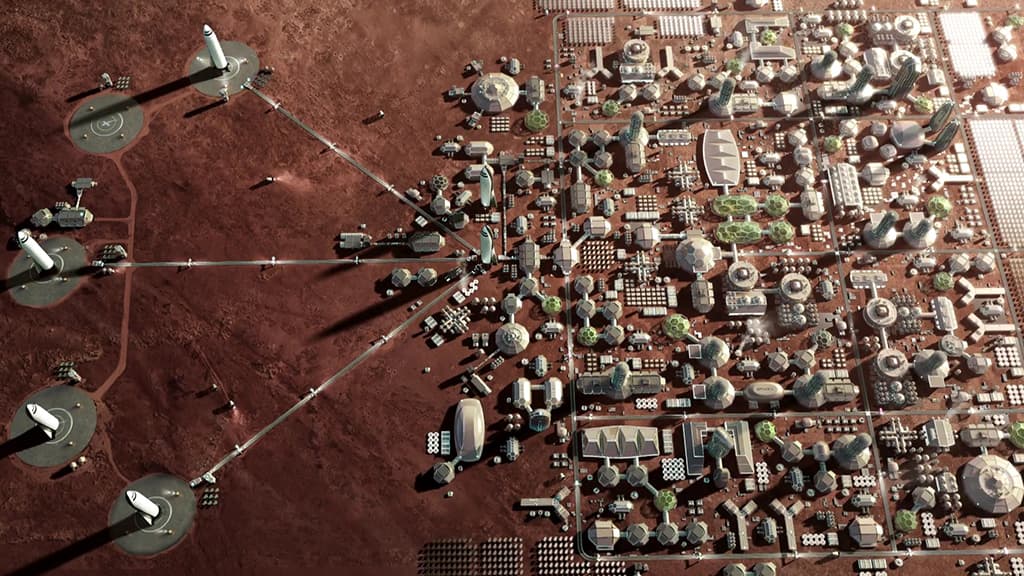
Essay | The Enstasis of Elon Musk by Tamar Shafrir
Department
Materialisation in Art and DesignTamar Shafrir, tutor at finished Temporary Programme Materialisation in Art and Design (2015-2017) published essay The Enstasis of Elon Musk with unthinking photography June 2019.
For the thickness of the shafts must be enlarged in proportion to the increase of the distance between the columns...the air seems to eat away and diminish the thickness of such shafts...they are sharply outlined by the unobstructed air round them, and seem to the beholder more slender than they are. Hence, we must counteract the ocular deception by an adjustment of proportions...For the eye is always in search of beauty, and if we do not gratify its desire for pleasure by a proportionate enlargement in these measures, and thus make compensation for ocular deception, a clumsy and awkward appearance will be presented to the beholder. With regard to the enlargement made at the middle of columns, which among the Greeks is called ἔντασις [entasis]...an agreeable and appropriate effect may be produced by it.
—Vitruvius, De architectura, 15 B.C., from Book 3, Chapter 3 (Temples and the orders of architecture: The proportions of intercolumniations and of columns)
The idea that an architectural rendering can be ‘real’ or ‘fake’ involves a transference of the logic of one medium—building—to the logic of another—drawing. Architectural rendering has always exploited the potentials of the page or canvas where money, knowledge, taste or gravity proved prohibitive. The most famous historical examples of this exploitation of the image would be Giovanni Battista Piranesi and Étienne-Louis Boullée, predecessors of more modern practitioners such as Le Corbusier, Archigram, Superstudio, Lebbeus Woods, and early Zaha Hadid.
Since the 19th century, when the École des Beaux-Arts formalised the architectural drawing in its modern conception—not only in its aesthetics but also as the conceptual key to the building—one could argue that the architect has become less implicated in building than in drawing as an aesthetic code, an act of creative production, a tool of communication, a set of instructions and a legal requirement. This split was ossified by the increasing technical expertise and clean office environment necessary to work with reproducible drawings like Mylar, cyanotype, pen plotters, and most obviously, computers. Indeed, one could say that architecture is more about communication than building, except for the brief periods of Modernist architecture in the 20th century that coincided with the dire need for new mass housing, namely after WWI and WWII and during Communism.
Read more: https://unthinking.photography/articles/the-enstasis-of-elon-musk