Q&A with Phantom Scores, the new temporary MA Sandberg
Phantom Scores is the new temporary master’s programme starting in September 2026 at Sandberg Instituut. The course approaches performance as a research methodology and explores the “phantoms” that inhabit our daily lives. It is closely connected to rituals, community engagement, and experiments with the idea of scores as frameworks for action.
The MA aims to equip participants with tools to engage with the unseen, unacknowledged, erased, disappeared, and yet still here. The programme brings together research and art practices of the undisciplined, de-genred intersections of performance studies, heart epistemologies, anti-colonial and anti-racist thinking, lived experience, situated knowledge, critical theories and DIY technologies.
You can learn more about the programme here.
Below is an edited transcription of the online Q&A session from open day 2026 with course director Eva Posas, and Sara Giannini (programme curator) and Anik Fournier (curator of archive and research) from the programme’s partner organisation, If I Can’t Dance.
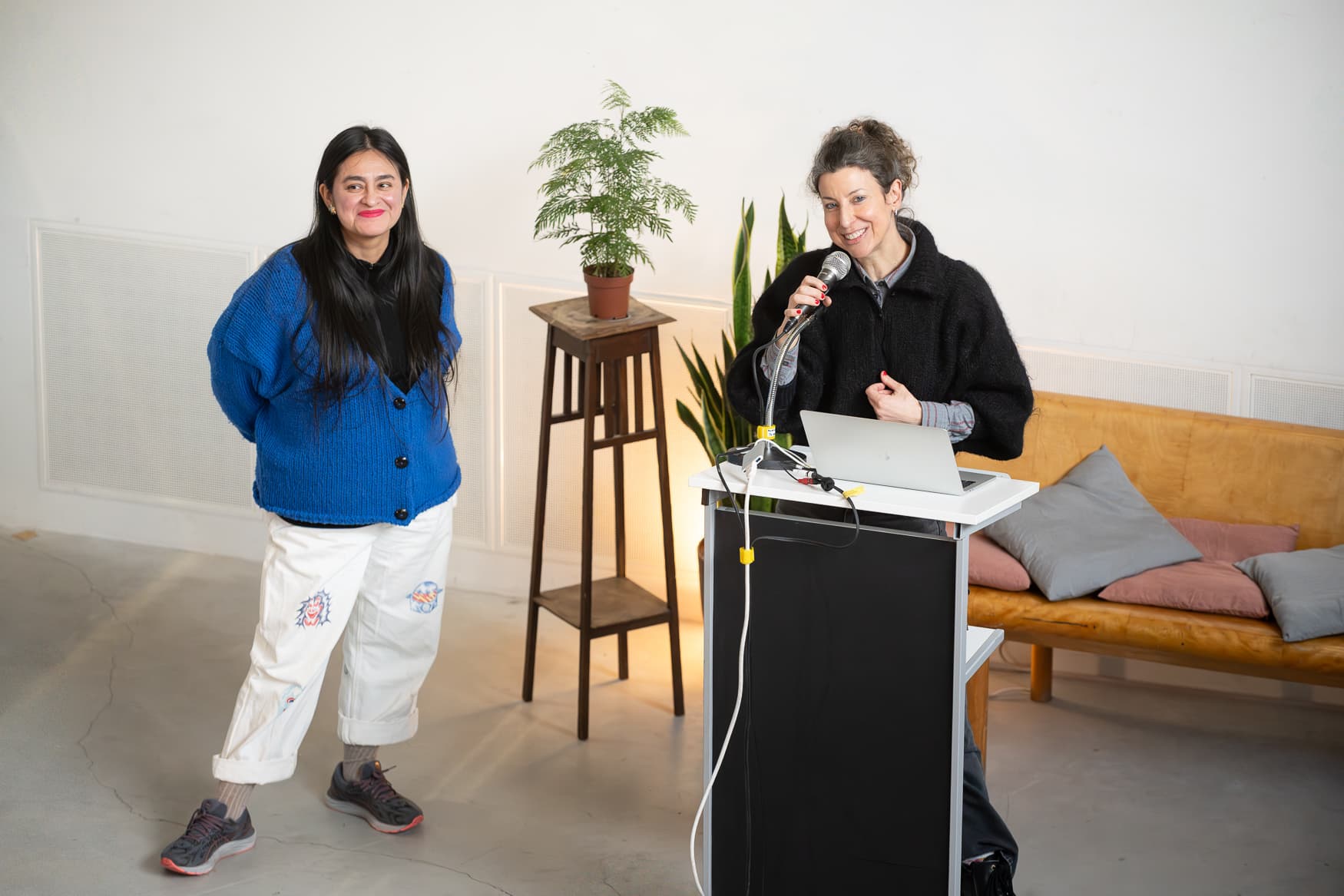
Eva Posas and Anik Fournier, Open Day 2026. Photo by Sander van Wettum.
How should applicants submit portfolios, and how can they share work related to phantoms and scores?
The portfolio is important and you’re welcome to share examples of your work. However, we especially encourage applicants to focus on their research proposal. For us, this is a key way to understand how you perceive the programme and how your interests connect to its themes. That’s also why we’ve included additional questions in the application, such as how you relate to performance, how you interpret the idea of the “phantom,” and even your relationship to reading. These responses will be very helpful in the selection process.
What matters most in the application?
One of the most important components is the research project you propose. This gives us insight into your thinking, your motivations, and how you might engage with the programme’s framework.
Does the research proposal need to relate to previous work, or can it be something entirely new?
It can be either. It’s often valuable when a project grows out of something you’ve already been exploring, since the programme can help you deepen and develop it further with the support of tutors and peers. What matters most is that it’s something you want to nurture and continue developing beyond the two years of the programme.
What are you hoping to understand about applicants through their proposals?
We want a clear sense of your practice and how your research question might benefit from the collective inquiry we’ll undertake. We’re interested in how your work and the programme might feed into each other.
Are you only looking for performance-based practices?
Not at all. We’re curious about many different kinds of practices. Some applicants have asked whether we engage with publishing, printing, or writing, and the answer is yes. Writing, for example, is something we value as a tool for thinking and reflection. It’s not about overwhelming you with theory or requiring you to be on stage. Instead, we’re interested in a wide range of experimental approaches to performance and how different disciplines might intersect with it.
What kind of backgrounds do you expect applicants to have?
This is an art institution, so many applicants will likely be developing artistic practices, such as artists or curators. However, we also welcome people from other disciplines, including socially engaged practitioners, craftspeople, musicians, or those from the humanities. The main requirement is a bachelor’s degree or equivalent qualification. Beyond that, what matters most is an interest in performance as a research methodology and an engagement with the programme’s themes, such as the concept of “phantoms.”
How large will the cohort be?
We aim for around 25 students, which allows for an intimate learning environment.
What kind of spaces and facilities will students use?
Students will share a main classroom space rather than having individual studios. There is also a movement space shared with the current temporary programme Monstrous Futurities, as well as additional facilities across the institution, including workshops and studios that students can freely use.
One of the key spaces available is a former medical lecture theatre that was part of a women's clinic. This is where If I Can’t Dance is currently based. It has a stage and tiered seating, which we’re excited to disrupt and reinterpret. The programme is interested in performance beyond the spectacular, so we want to explore ways of using it that kind of go against this idea of, like, a body on a stage. We’re very excited to see what can be done with a cohort of students. Unfortunantely, the building is on the second floor and currently does not have elevator access, so accessibility needs will be considered carefully depending on the cohort.
What resources will students have access to?
In addition to institutional facilities, students will engage with extensive archival materials, publications, and knowledge connected to the programme’s research context. There is a strong emphasis on cross-department collaboration and shared learning across the institution.
Is there a “home base” for the programme?
Yes. While students will use facilities across the institution, the programme’s central base will be a dedicated shared classroom space, with additional activities and resources connected to its partner organisation.
The application form has separate sections for “project proposal” and “research interests.” What’s the difference?
These are two distinct components. The project proposal is a required element where you outline a specific research project you’d like to pursue. It can grow out of something you’ve already been working on or be a new direction you want to explore. The research interest questions, on the other hand, focus more broadly on your interests, perspectives, and how your practice relates to the themes of the programme.
If you have further questions about the programme, please feel free reach out to: phantom.scores@sandberg.nl
For information about the application procedure and to apply, visit sandberg.nl/apply-now. Applications are accepted until April 1, 2026.
More about fees, housing, and the Sandberg community can also be found over at sandberg.nl/financial-information
We look forward to receiving your applications!
Open Day 2026 – Phantom Scores (New Temporary Programme)